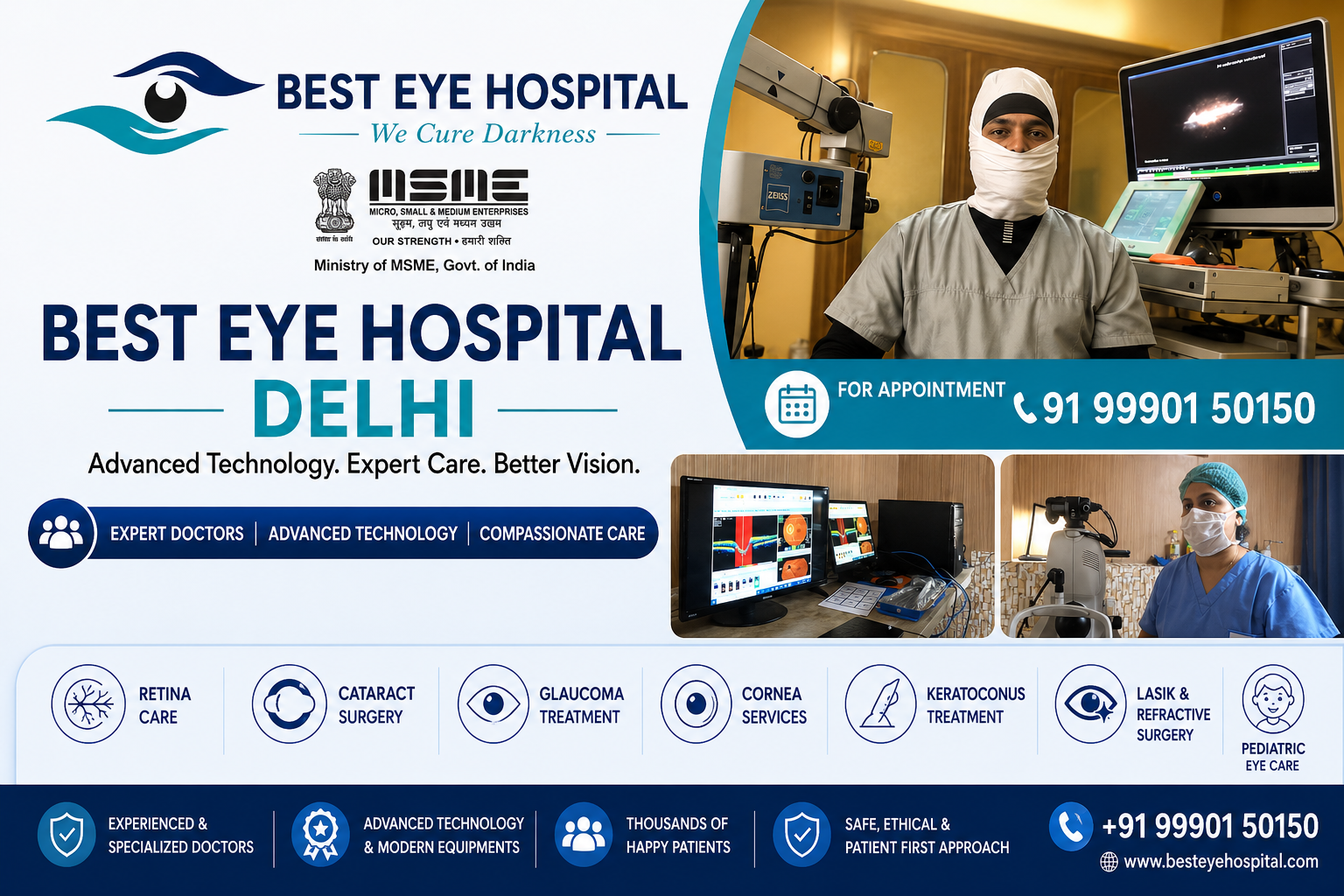
Best Eye Hospital ,Advanced Cornea Diagnosis, Medical & Surgical Treatment
Comprehensive Cornea Care for All Corneal Diseases
The cornea is the clear, transparent front surface of the eye that plays a vital role in focusing light and providing clear vision. Any disease, injury, infection, thinning, swelling, scarring, or irregularity of the cornea can significantly affect vision and quality of life.
At Best Eye Hospital, Delhi, we provide comprehensive diagnosis and treatment of corneal disorders using advanced imaging technology, modern medical therapies, corneal cross-linking, laser treatments, and corneal transplantation procedures.
Our specialists manage simple to highly complex corneal diseases in adults and children.
What is the Cornea?
The cornea is the transparent front window of the eye. It:
- Focuses light entering the eye
- Protects the eye from dust, infection, and injury
- Works together with the natural lens to produce clear vision
Because the cornea is responsible for approximately two-thirds of the eye’s focusing power, even minor corneal abnormalities can significantly affect vision.
Common Symptoms of Corneal Disease
You should seek evaluation if you experience:
- Blurred vision
- Decreased vision
- Eye pain
- Redness
- Light sensitivity
- Excessive tearing
- Foreign body sensation
- Burning or irritation
- Recurrent eye infections
- Corneal opacity or white spot
- Double vision
- Progressive change in spectacle number
Advanced Cornea Diagnostic Centre
Early diagnosis is critical for successful treatment.
Comprehensive Corneal Evaluation Includes
Slit Lamp Digital Examination
Detailed assessment of the corneal surface and layers.
3d Corneal Scanning
Computerized mapping of corneal curvature.
Essential for:
- Keratoconus detection
- Corneal thinning disorders
- Refractive surgery evaluation
- All Corneal Pathology
3d Corneal Tomography
Three-dimensional imaging of the cornea.
Provides detailed information regarding:
- Corneal thickness
- Posterior corneal surface
- Early ectatic disorders
Pachymetry
Precise measurement of corneal thickness.
Important in:
- Keratoconus
- Corneal thinning disorders
- Glaucoma assessment
Three Dimensional Optical Coherence Tomography (OCT)
High-resolution imaging of corneal layers.
Specular Microscopy
Evaluation of corneal endothelial cells.
Used for:
- Corneal edema
- Fuchs’ dystrophy
- Corneal transplant assessment
Tear Film Analysis
Assessment of:
- Dry Eye Disease
- Tear film stability
- Ocular surface disorders
Corneal Sensitivity Testing
Used in neurotrophic and complex corneal diseases.
Non Invasive Dry Eye test :- Close Chamber thermometery & Humidity
Visit www.ThedryEye.com
Corneal Diseases We Treat
Keratoconus
A progressive thinning and bulging of the cornea causing distorted vision.
Symptoms include:
- Frequent change of glasses
- Increasing astigmatism
- Blurred vision
- Night vision problems
Treatment options:
- Corneal Cross-Linking (CXL)
- Specialty Contact Lenses
- Intracorneal Ring Segments
- Corneal Transplantation in advanced cases
Corneal Thinning Disorders
We diagnose and manage:
- Keratoconus
- Pellucid Marginal Degeneration
- Post-LASIK Ectasia
- Keratoglobus
- Corneal Ectatic Disorders
Advanced imaging helps detect thinning at the earliest stage.
Corneal Infections (Keratitis)
Caused by:
- Bacteria
- Fungi
- Viruses
- Parasites
Symptoms include:
- Severe pain
- Redness
- Watering
- Vision loss
Prompt treatment is essential to prevent permanent corneal scarring.
Corneal Ulcers
Medical emergencies requiring urgent treatment.
Advanced microbiological investigation and targeted therapy help preserve vision.
Dry Eye Disease & Ocular Surface Disorders
Our centre provides advanced management of:
- Dry Eye Disease
- Meibomian Gland Dysfunction
- Computer Vision Syndrome
- Ocular Surface Inflammation
- Recurrent Corneal Erosion
Treatment may include:
- Lubricating eye drops
- Anti-inflammatory therapy
- Tear conservation procedures
- Advanced ocular surface management
Corneal Scars & Opacities
Corneal scarring may result from:
- Infection
- Injury
- Chemical burns
- Previous surgery
Treatment options vary depending on severity.
Corneal Dystrophies
Management of inherited corneal disorders including:
- Fuchs Endothelial Dystrophy
- Lattice Dystrophy
- Granular Dystrophy
- Macular Dystrophy
Corneal Edema & Endothelial Disorders
Treatment of:
- Fuchs Dystrophy
- Bullous Keratopathy
- Endothelial Failure
- Post-Surgical Corneal Edema
Chemical & Thermal Eye Injuries
Emergency management of:
- Chemical burns
- Industrial injuries
- Thermal injuries
Early intervention is critical to maximize visual recovery.
Medical Treatment for Corneal Diseases
Depending on diagnosis, treatment may include:
Advanced Eye Drops
- Antibiotics
- Antifungal medications
- Antiviral medications
- Anti-inflammatory therapy
- Lubricants
- Immunomodulators
Biological Therapies
Selected patients may benefit from:
- Autologous Serum Eye Drops
- Platelet Rich Plasma (PRP) Therapy
- Advanced Ocular Surface Rehabilitation
Dry Eye Management
Customized treatment protocols for mild to severe dry eye disease.
Dry Eye Close Chamber thermometery & Humidity
Visit www.ThedryEye.com
Advance Corneal Cross-Linking (CXL)
Treatment for Keratoconus & Corneal Thinning
Corneal Cross-Linking strengthens the cornea and helps slow or stop progression of keratoconus.
Benefits:
- Stabilizes corneal thinning
- Reduces progression
- Preserves vision
- May delay or prevent corneal transplantation
Surgical Treatment of Corneal Diseases
Corneal Transplantation (Keratoplasty)
Performed when corneal disease significantly affects vision.
Penetrating Keratoplasty (PKP)
Full-thickness corneal transplant.
Deep Anterior Lamellar Keratoplasty (DALK)
Selective replacement of diseased corneal layers while preserving healthy endothelium.
Endothelial Keratoplasty
Includes:
- DSEK
- DSAEK
- DMEK
For endothelial disorders such as Fuchs dystrophy.
Amniotic Membrane Transplantation
Used for:
- Non-healing ulcers
- Chemical injuries
- Ocular surface reconstruction
Pterygium Surgery
Advanced techniques aimed at:
- Lower recurrence rates
- Better cosmetic appearance
- Improved comfort
Corneal Reconstruction Procedures
Management of complex:
- Corneal perforations
- Severe thinning
- Trauma
- Ocular surface disease
Cornea, Cataract & Refractive Surgery Evaluation
Comprehensive assessment before:
- Cataract Surgery
- LASIK
- PRK
- SMILE
- Refractive Lens Exchange
Advanced corneal imaging helps optimize surgical outcomes.
Pediatric Corneal Services
Evaluation and treatment of:
- Congenital corneal disorders
- Pediatric keratoconus
- Corneal infections
- Corneal injuries
Why Choose Best Eye Hospital for Cornea Care?
 Dedicated Cornea Specialists
Corneal Topography & Tomography
Corneal OCT Imaging
Specular Microscopy
Pachymetry
Advanced Dry Eye Centre
Corneal Cross-Linking (CXL)
Keratoconus Management
Corneal Infection Treatment
Corneal Transplant Surgery
DALK, DSEK, DMEK & PKP Procedures
Ocular Surface Reconstruction
Management of Complex Corneal Diseases
Frequently Asked Questions
What is keratoconus?
Keratoconus is a progressive thinning and bulging of the cornea that causes distorted vision and irregular astigmatism.
Can corneal thinning be treated?
Yes. Early diagnosis and treatments such as Corneal Cross-Linking can help stabilize many corneal thinning disorders.
Is corneal transplantation successful?
Modern corneal transplantation procedures have excellent success rates when performed in appropriate candidates.
Can dry eyes damage the cornea?
Yes. Severe dry eye disease can affect the corneal surface and vision if left untreated.
What tests are used to diagnose corneal disease?
Corneal Topography, Tomography, OCT, Pachymetry, Specular Microscopy, and detailed slit lamp examination are commonly used.
Corneal Transplant Surgery (Keratoplasty)
Advanced Corneal Grafting & Corneal Transplant Centre
A corneal transplant (keratoplasty) is a surgical procedure in which diseased, scarred, swollen, or damaged corneal tissue is replaced with healthy donor corneal tissue.
Corneal transplantation can:
Restore vision
Reduce pain and discomfort
Improve corneal clarity
Improve the appearance of a damaged eye
Help patients regain independence and quality of life
This sight-restoring procedure has transformed the lives of thousands of patients, from children and young adults to senior citizens suffering from corneal blindness and severe corneal diseases.
Our cornea specialists, including Dr. Hanspal Singh Bhinder and Dr. Amrit Kaur, provide comprehensive evaluation and advanced corneal transplantation procedures using modern surgical techniques.
Understanding Corneal Blindness
The cornea must remain clear and transparent for normal vision.
When the cornea becomes:
- Cloudy
- Scarred
- Swollen
- Infected
- Thinned
- Distorted
Light entering the eye cannot focus properly, causing blurred vision or severe visual impairment.
Many patients describe their vision as:
- Looking through frosted glass
- Looking through a foggy window
- Severe glare and distortion
- Only being able to perceive light
In appropriate cases, corneal transplantation can significantly improve vision and visual quality.
What Happens During a Corneal Transplant?
The diseased portion of the cornea is carefully removed and replaced with healthy donor corneal tissue obtained through authorized eye banks.
The procedure is performed using advanced microsurgical techniques under high magnification.
Depending upon the disease affecting the cornea, either the full thickness or selected layers of the cornea may be replaced.
Types of Corneal Transplant Surgery
Penetrating Keratoplasty (PKP)
Traditional full-thickness corneal transplant surgery.
Recommended when all layers of the cornea are affected.
Deep Anterior Lamellar Keratoplasty (DALK)
A modern partial-thickness transplant procedure.
Only diseased front layers of the cornea are replaced while preserving the patient’s healthy inner endothelial layer.
Benefits include:
- Lower rejection risk
- Better structural strength
- Faster recovery in selected patients
Commonly performed for:
- Keratoconus
- Corneal thinning disorders
- Corneal scars
Lamellar Keratoplasty
Selective replacement of affected corneal layers while preserving healthy tissue.
This technique may offer faster recovery and lower rejection rates in suitable patients.
Endothelial Keratoplasty
Used when only the innermost endothelial layer is diseased.
DSEK / DSAEK
(Descemet Stripping Endothelial Keratoplasty)
Suitable for:
- Fuchs Endothelial Dystrophy
- Bullous Keratopathy
- Endothelial Failure
DMEK
(Descemet Membrane Endothelial Keratoplasty)
An advanced endothelial transplant procedure offering excellent visual outcomes in selected patients.
Common Indications for Corneal Transplantation
Corneal grafting may be recommended for:
Keratoconus & Corneal Thinning Disorders
Progressive corneal thinning causing visual distortion.
Corneal Scarring
Due to:
- Injury
- Infection
- Previous surgery
Corneal Ulcers
Severe infections leading to corneal destruction.
Pseudophakic Bullous Keratopathy
Corneal decompensation occurring after cataract surgery.
Fuchs Endothelial Dystrophy
Progressive endothelial cell dysfunction causing corneal swelling.
Viral Corneal Diseases
Including:
- Herpes Simplex Keratitis
- Varicella Zoster Keratitis
Fungal Keratitis
Advanced fungal infections resulting in corneal damage.
Congenital Corneal Opacities
Corneal disorders present at birth.
Chemical & Thermal Eye Injuries
Corneal damage caused by burns and trauma.
Traumatic Corneal Damage
Corneal opacity resulting from accidents and injuries.
Corneal Donor Tissue
Corneal transplantation uses carefully screened donor corneal tissue obtained through certified eye banks.
Each donor cornea undergoes detailed quality evaluation before transplantation.
Corneal Transplant Success & Recovery
Modern corneal transplantation has excellent success rates when performed for appropriate indications.
Recovery depends on:
- Type of transplant
- Underlying disease
- Eye health
- Healing response
Regular follow-up visits are essential for optimal outcomes.
Why Choose Best Eye Hospital for Corneal Transplantation?
Dedicated Cornea Specialists
Advanced Corneal Imaging
Keratoconus & Corneal Thinning Centre
DALK, DSEK, DMEK & PKP Procedures
Corneal Cross-Linking (CXL)
Complex Corneal Reconstruction
Management of Corneal Infections & Ulcers
Pediatric Corneal Disease Management
Comprehensive Post-Transplant Care
Experienced Corneal Surgery Team
Restore & Protect Your Vision with Expert Cornea Care
Whether you have keratoconus, corneal thinning, infection, dry eye disease, corneal scarring, or require corneal transplantation, our specialists provide comprehensive diagnosis and personalized treatment using the latest medical and surgical technologies.
Best Eye Hospital, Delhi
Cornea Specialists | Keratoconus Centre | Corneal Cross-Linking | Corneal Transplant Surgery | Advanced Ocular Surface Care